
Retail Academy
Retail is an ever-present part of our lives and communities. From the weekly grocery gathering to back-to-school shopping sprees or maybe just a bit of “retail therapy,” access to convenient and well-appointed retail stores helps to make our lives that much easier, and our communities feel even more like home. As economic developers, retail means jobs, quality of life, and a more satisfied community. Quality retail is a goal of economic developers the world over, but what does it take for a community to attract these kinds of projects?
In early January 2026, team members from Georgia Power Economic Development and leaders from Carroll, Cornelia, and Dublin, Georgia traveled to the headquarters of Retail Strategies to participate in Retail Academy in hopes of answering that question for themselves.
The Retail Academy events are educational courses that assist communities in bringing retail to their area. Participants gain insights into best practices, learn to implement strategies, and receive guidance and tools for successful retail development.
The Academy was sponsored through Georgia Power Economic Development's “Retail Ready” program, an initiative to support communities in Georgia who have demonstrated an interest and ability to include retail attraction and development into their overall economic development strategy.
“Business attraction doesn’t happen in silos. By attending the Retail Academy alongside Carroll’s leaders and key partners, we ensure our strategies are aligned, our resources are leveraged effectively, and our efforts are coordinated. This shared approach allows us to move forward with clarity and purpose, working collectively toward realistic, attainable goals that strengthen our economy and create lasting benefits for the entire community.”
Over two days, academy facilitators covered trends and strategies in attracting national brands to a trade area, while reviewing each region’s potential to capture new retail.
By the end of the session, one thing was evident. The only way to successfully prepare for and attract national brands is to be honest about your community.
Let’s Be Honest
As economic developers, we often see our regions through rose-colored glasses. We can envision the potential in a corner lot that has sat vacant for years, had conversations at the local diner with residents who tell us they would shop at “top line grocery” if it was closer, and have talked in passing with the permitting office about the idea of rezoning a corridor.
It's our job to be visionary leaders for a region and inspire our partners and communities to help realize that vision. However, community conversations and dreams do not show up in the data when a national brand is researching markets for their next location.
This should not discourage communities from retail attraction but help them align their dreams with the factors that make retail attraction possible. Below are three things you can do now to have meaningful conversations with growing brands.
Brands know their customers – do they live in or frequent your trade area?
National brands invest a lot of resources into understanding their customers. Everything from a customer’s household income to decision-making patterns play a role in determining a brand’s ideal next location.
It is crucial for communities to analyze the customer base within a trade area, rather than focusing solely on population growth or the number of rooftops. Communities should rely on objective data rather than optimistic projections about the economic outlook in the coming years.
By accurately assessing current customer spending power and aligning consumer behaviors with appropriate brands, communities can facilitate more effective discussions with companies that are well-suited for their region.
Businesses locate to real sites – where are yours?
Economic developers cannot approach a national brand with “potential locations.” Having a firm understanding of a site and its potential to attract a company’s customers is critical to building trust and capturing the attention of a national brand.
The factors vary for each brand, but at a minimum, you need to know.
- Site Availability
Ownership of site and its availability for purchase or lease. If you have not been in contact with the owner and discussed your community’s vision and gained buy-in from the owner or operator, then this site is not ready to market.
- Zoning and Permitting
Is the site approved for the specific retail-use? In addition to the by-right zoning for business use, consider the sign ordinance and timeline for permitting. Economic developers are valuable in the project when they can reduce risk and help improve the speed-to-market for a business operating in your market.
- Traffic and Parking
Utilizing the Georgia Department of Transportation or a vendor, it’s crucial to know how often and when customers drive by or to/from a shopping corridor. Expand this information to the site’s access which includes traffic times and all entry and egress points for the property.
Parking will be another crucial factor in determining a location’s feasibility for success. This includes not only the parking requirements in your local ordinance but also the potential parking, rather it be shared, free, or neighboring parking. Having clear aerial visuals of this should be in your marketing packet.
- Size
Commercial leases require precision since each additional square foot adds costs to a lease. When marketing a property, include the exact square footage (ex. 26,431 instead of 26,400) as well as any ability to divide the property.
Brands come in pairs – who is missing from your retail mix?
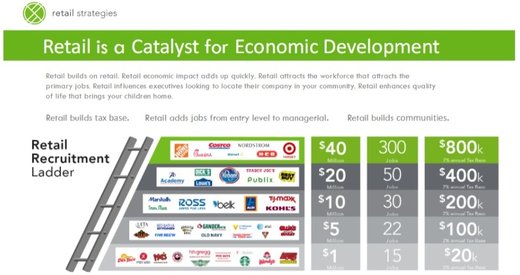
Retail builds on retail. Brands with similar customer bases are often located in the same corridor. As one tier of retailers strengthens and a community’s population and spending power grows, a higher tier of retail can follow - one step at a time.
You can picture this as a ladder where each step is developed together within your community.
Communities need to review their existing retail mix and its current profitability. If the current retailers are succeeding, are there any likely pairs that would be a good fit in your corridor?
In Conclusion
Retail decisions are not personal; they are about opening profitable locations.
Understanding which national brands can be profitable in your market and which sites are appropriate for them to locate improve the discussions you will have with real estate brokers and tenant reps.
How We Can Help
Your Regional Economic Development Manager can facilitate these discussions. Discussing your goals, we can support your region with data and analysis, strategic planning support, and more. Start the conversation today.
Stay posted for more on Retail Ready in 2026, including additional summaries from the Retail Academy and best practices implemented by our community participants.
Planning for Retail Recruitment
Oct 29, 2025